ERDF-funded development projects

Novellop Technologies is carrying out two research and development projects funded under the ERDF/JTF NRW 2021–2027 program. The projects focus on the fields of terrestrial photovoltaics and space technology, each pursuing specific technological approaches.

InnoZell – SiGe:C quantum well solar cells

Development of multilayer semiconductor structures for highly efficient crystalline solar cells

Funding guidelines: EFRE.NRW – GrüneGründungen.NRW

Funding agency: Ministry of Economic Affairs, Industry, Climate Protection, and Energy of North Rhine-Westphalia / EU (ERDF)

Project management: Novellop Technologies GmbH

Project duration: February 1, 2025 – January 31, 2028 (36 months)

Objective

Crystalline silicon solar cells currently achieve efficiencies of about 20–25%, approaching the theoretical limit for single-junction cells. The InnoZell project is developing quantum well structures made of silicon, germanium, and carbon (SiGe:C) that are integrated into silicon solar cells to broaden their spectral sensitivity.
These multilayer semiconductor structures enable the absorption of ultraviolet light, which is not utilized by conventional silicon cells. The development goal is to achieve efficiencies exceeding 30%. In parallel with increasing efficiency, the aim is to simplify the manufacturing process. By reducing wet chemical process steps, manufacturing costs can be significantly lowered, making the technology more economically attractive.

Technological Approach

The core challenge lies in the controlled PECVD deposition of SiGe and SiC layers on silicon wafers.
Germanium has a larger lattice constant than silicon, which is why layer thicknesses and temperatures must be precisely controlled to ensure crystalline quality.
Development proceeds in several iterative cycles: After systematically varying layer thicknesses and material compositions, prototypes are fabricated and characterized. Based on the measurement results, the structures are optimized until the target efficiency is achieved.
Prototype fabrication is carried out by external partners using specialized equipment. Novellop coordinates the process development and performs the metrological characterization.

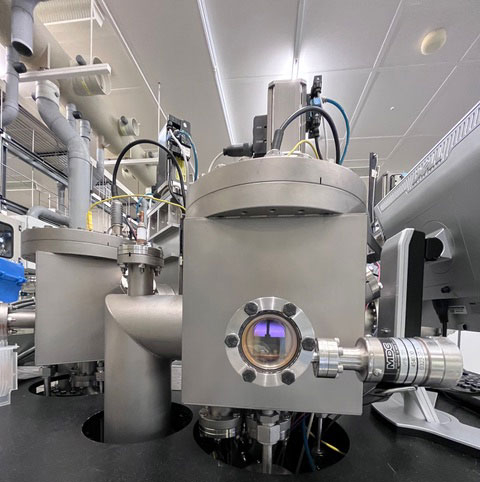
PECVD cluster equipment at TU Delft PV Technology Center (within the premises of Else Kooi Laboratory)

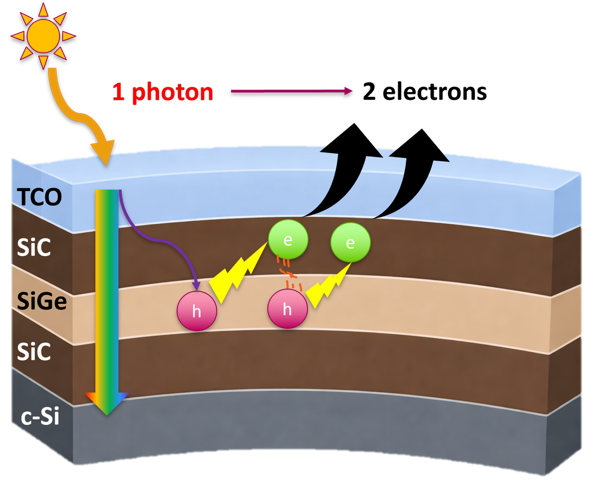
Structural diagram of a SiGe solar cell

The key challenge lies in the controlled PECVD deposition of SiGe and SiC layers on silicon wafers. These multilayer semiconductor structures enable the absorption of ultraviolet light, which is not utilized by conventional silicon cells.

Application potential

The technology is designed for large-scale terrestrial applications such as solar farms and building-integrated systems, where high power density per unit area is economically significant. Another area of application is space systems, particularly CubeSats, where high efficiency is critical given the limited space available.
Compatibility with established silicon technology facilitates future industrialization. Upon successful project completion, the goal is to establish manufacturing capabilities in collaboration with industry partners.

Funded by:


The InnoZell and PeroSat research projects are funded under the EFRE/JTF Program NRW 2021–2027 by the Ministry of Economic Affairs, Industry, Climate Protection, and Energy of the State of North Rhine-Westphalia and the European Union (European Regional Development Fund).

PeroSat – Perovskite solar cells for satellite applications

Development of ultra-lightweight, foldable solar modules for use in low Earth orbit

Funding guidelines: EFRE.NRW – GreenEconomy.IN.NRW

Funding agency: Ministerium für Wirtschaft, Industrie, Klimaschutz und Energie NRW / EU (EFRE)

Project coordination: Bergische Universität Wuppertal (Dr. Kai Oliver Brinkmann, Prof. Dr. Thomas Riedl)

Project duration: October 1, 2025 – September 30, 2028 (36 months)

Network partners:

  • University of Wuppertal
  • University of Potsdam
  • Kunststoffverarbeitung Hoffmann GmbH
  • NTTF Coatings GmbH
  • Novellop Technologies GmbH

Objective

Commercial spaceflight is expanding rapidly, particularly in the field of small satellite constellations. These require cost-effective and extremely lightweight power systems. While conventional gallium arsenide solar cells are efficient, they are heavy and expensive.
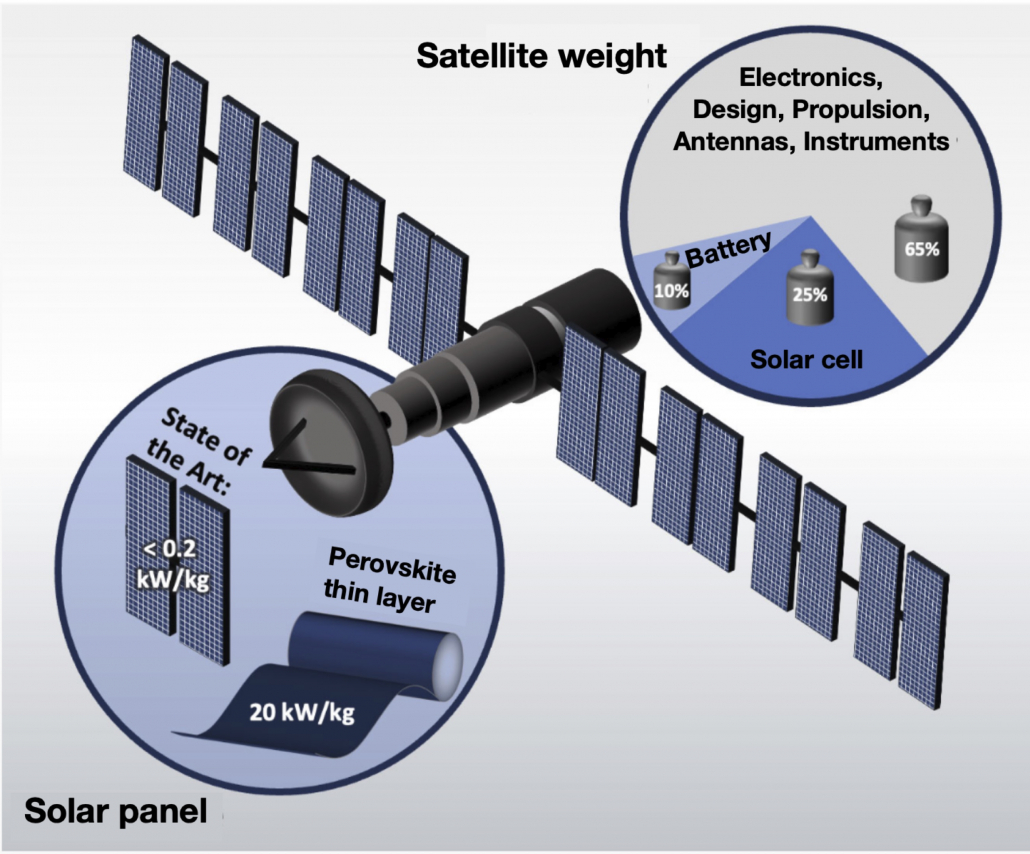
Perovskite solar cells offer an exceptional power-to-weight ratio of up to 20 W/g, resulting in a specific power output roughly a hundred times higher than that of conventional space solar cells. Given typical transportation costs to space, this leads to a significant reduction in the cost per installed kilowatt.
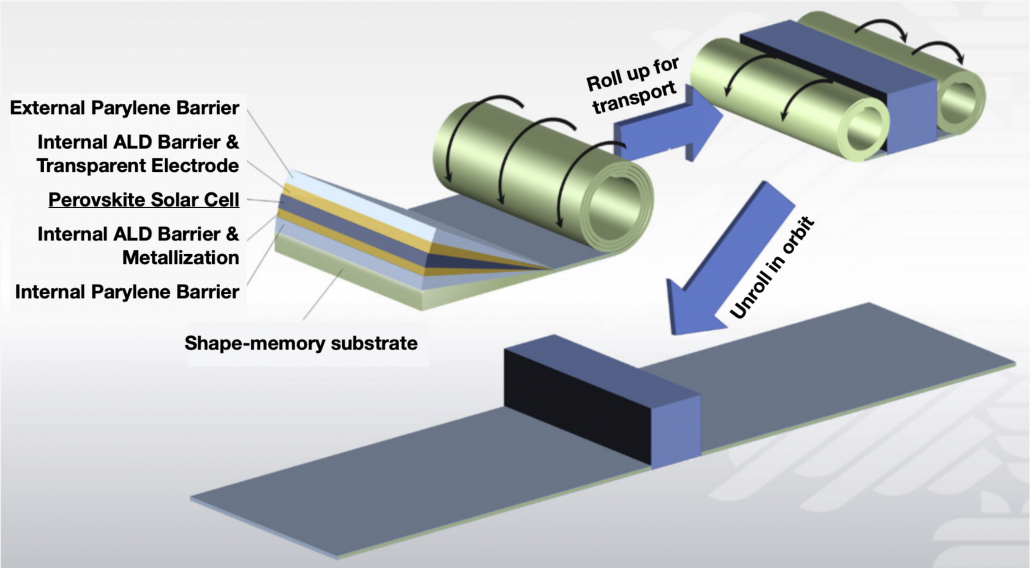
The PeroSat collaborative project is developing perovskite modules on flexible shape-memory substrates that can be compactly folded for rocket launch and automatically unfolded in orbit. The central challenge lies in stabilizing the modules against extreme space conditions: vacuum, UV radiation, temperature cycles, and atomic oxygen.

Technological Approach

The project combines several innovations: The University of Wuppertal is developing UV-resistant and thermally stable perovskite solar cells. NTTF Coatings is developing multilayer permeation barriers that prevent outgassing in a vacuum. Kunststoffverarbeitung Hoffmann manufactures flexible PEEK substrates with integrated shape-memory alloys.

Role of Novellop Technologies

Novellop handles the system integration: We assemble the components developed by our partners into fully functional modules. This includes the overall mechanical structure, the electrical circuitry on flexible substrates, the integration of deployment mechanisms, and the connection to standardized CubeSat structures.
Development takes place in two stages: First, rigid prototypes are built on ultra-thin PEEK plates and characterized. In the second phase, fully foldable modules are realized on shape-memory substrates, and their functionality is verified under simulated space conditions.
The University of Potsdam validates all components under realistic orbital conditions in vacuum chambers with UV irradiation and thermal cycles.

Perovskite solar modules with the highest power-to-weight ratio

Perovskite solar cell with internal and external parylene barriers for rollable and foldable modules

Application potential

The technology is designed for large-scale terrestrial applications such as solar farms and building-integrated systems, where high power density per unit area is economically significant. Another area of application is space systems, particularly CubeSats, where high efficiency is critical given the limited space available.
Compatibility with established silicon technology facilitates future industrialization. Upon successful project completion, the goal is to establish manufacturing capabilities in collaboration with industry partners.

Funded by:


The PeroSat collaborative project is funded under the ERDF/JTF NRW 2021–2027 program by the Ministry of Economic Affairs, Industry, Climate Protection, and Energy of the State of North Rhine-Westphalia and the European Union (European Regional Development Fund) as part of the GreenEconomy.IN.NRW initiative.